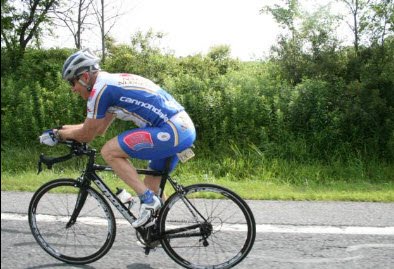
Thursday, June 10, 2010

*REPORT FROM THE ROAD: 6-10-2010 9:30 AM EDT*

(***Note of apology: The RAAM web site has had some bugs and as a result, this entry has changed a couple of times. As of noon EDT, the best information I have has Rob in fourth place and I believe that is now 100% accurate.***)

Just
had a nice chat with Rob and night crew driver Mike Desilet. They just checked into TS 5 in Salome, AZ. The sun had fully risen, so they were taking a quick break to change clothes and put some sun block on Rob for the day ahead.

In no particular order:
  • He feels great.
  • He rode with Jure for the first 20 miles of the race "...but had no delusions about staying with him."
  • He moved into fourth place overall during the night.
  • The third place guy is about 10 minutes up the road and second place is about an hour up the road.
  • All of this means exactly NOTHING at this early stage of the race, other than the fact that everything is going EXACTLY according to plan.
  • As is tradition for Rob on RAAM, the amplifier that powers the external speakers on the pace van is not working properly. This is the amp that blasts music for the whole race. They will be looking to buy a new amp today.
  • About 10 minutes after transition last night, Rob got a flat tire. Luckily, Jeff and Joe of the night crew brigade both work at The Bike Express in Danbury and had Rob back on the road with a new wheel in about 45 seconds. (If I was the one racing, that would have been my cue to say "That's it boys! We gave it our best shot! Let's pack this thing up and head home!"
More later after day crew transitions in.

Morning Math

Good Thursday morning, Robophiles. I have not yet spoken to the crew, but here's a quick look at what transpired overnight:

SUMMARY: Rob rode his bike really, really far.

DETAILS: Rob rode into TS 4 in Parker, AZ (283 total miles) at 5:22 AM race time. That is 13.5 hours after the start of the race. His average speed is a fairly astonishing 20.85 mph. If you extrapolate that pace out to 24 hours, he will do in the neighborhood of 500 miles in the first 24 hours. Yikes - that boy can ride!

Now, a few things to keep in mind:

- If you look at the climbing profile, you'll see that through about 300 miles, the climbing was either modest or even downhill. Today, they start going uphill. A lot. So average speeds will be coming down. The climb from Cottonwood to Flagstaff is heart (and knee) breaking.

Good thing for us, Rob has always been a mountain goat. He can climb.

But just bear all this in mind - average speeds WILL come down today. For everyone. And the separation between riders will grow dramatically because everyone can ride downhill and most decent riders can maintain speed on the flats, but the real physical challenge comes on the climbs. I emphasize physical because the mental challenges in RAAM come in places like Kansas, where they might ride for a day-and-a-half into a headwind. But we'll cross that road when we come to it.

I hope to speak to the pace van later this morning for an update from the road.

Wednesday, June 9, 2010

*REPORT FROM THE ROAD: 6-9-2010 10:20 PM EDT*

Here's a nice pre-race shot of smilin' Rob Morlock, just before the start:


John Browne checked in a few minutes ago, just after the transition from day crew to night crew. He says all is going perfectly. Rob feels great and is enjoying a nice tailwind on his way into TS2 in Brawley, CA.

For the curious, here's how crew transition works:

Once the sun sets, the rider and his pace vehicle are to be treated as a single unit. THEY CAN NOT BE SEPARATED for safety reasons. So, after dark, if the van stops, Rob has to stop.

For this reason, the transition from day crew to night crew will take place about 1/2 hour before sunset. This allows the crew to give Rob fresh bottles of food and water and send him up the road by himself for about 15 minutes.

The shuttle van parks on the side of the road and waits for Rob to ride by. The pace van then pulls up in front of the shuttle van and you have about 5-10 minutes of controlled chaos. Fresh water is brought in, along with a fresh cooler of groceries and food for Rob and the night crew. Rob's clean laundry is brought in and dirty laundry hauled out.

Each member of the day crew will brief his night crew counterpart on items of note. For example:

- The day crew driver might tell the night crew driver that Rob want him to stay about 20 feet behind him, not 30 feet, and to crank the music.

- The two navigators will talk about Rob's mood, health etc.

- The two mechanic/chefs will discuss any bike issues or perhaps Rob's food preferences (besides his Spiz.)

Then, the night crew gets into the pace van and drives up the road until they catch up to Rob and settle in right behind him. The music comes on and Rob gets ready for a night on the bike.

Tonight's crew:

- Mike Desilet (driver)
- Jeff Sturges (navigator)
- Joe Murphy (mechanic/chef)

Rob will not sleep tonight. He'll ride straight through, 12 hours, until the transition back to day crew and the cycle starts all over again, for another 12-hour day shift.

Some random thoughts:

  • At this point, it's too early to read any tea leaves. Through Time Station (TS) 1, Rob was in 6th place. Nothing good or bad about that, other than he took it nice and easy, averaging just under 18 mph. Thirty minutes separates 1st place from 10th place. Patterns will start to form after about 36 hours. The only metaphysical certitude is that Jure Robic will be out in front. Everyone else will still be working out their place in the long-haul pecking order.
  • When you look at the arrival and estimated time station times posted, everything is based on east coast time. They call this "race time". The reason? Since the riders will be going through four time zones during the course of the race, it would be impossibly confusing to report things in local time. Since they are all heading east, Eastern Daylight Time is the official standard for reporting everything in the race.
  • This enormity of this race can not be overstated. Anything that happens in the first 3-4 days has little meaning on the ultimate outcome. Some people have said that the real race begins at the Mississippi River. Anyone who has ever run a marathon knows NOT to go out too fast at the start. Well, multiply that by a bazillion and that's RAAM.
So, enjoy a good night's sleep and think about Rob, out there in the California desert, pedaling his bike and jamming to some Jethro Tull or Moby. And we'll see you right back here on Thursday morning.

Why You Should Have Paid Attention in Math Class


Remember 7th grade pre-algebra word problems?:

"Solve for Z:

Robbie and Timmy get on their bicycles in California and start riding east.

X= the fact that Timmy is listening to Neil Diamond.

Y= the fact that Robbie is listening to Black Sabbath.

Z= How many RAAM crew members will wish they had vacationed in Cleveland by the time Robbie reaches the Mississippi River"


See - you DO need math after all!

In truth, RAAM is one big time/distance problem. The key to everything is miles per day. On its face, it is all quite simple: 3,000 miles/300 miles per day = 10 day crossing.

A 10-day RAAM is a nice goal to shoot for.

Typically, when a rider is fresh, he/she will do more miles per day in the first few days and then that will come down as the racer tires. So, someone might average 340 miles/day for the first two days. Then he will sleep and the next two days, that daily total might come down to 320. By the time he reaches the last three days, he might be so exhausted, he can only squeeze out 280 miles/day.

But there are a lot of other factors that affect average speed, including wind, heat, medical issues, mechanical unknowns.

But, for the sake of establishing a benchmark, we'll look for Rob to do a 10 day crossing and adjust upward or downward based on what actually happens on the road.

It really is one big math problem, so all you kids at Danbury High who are following Officer Morlock: get to math class!

Jure Robic is an animal

I just noticed that, even though he was the last to start, Jure Robic was the first to reach TS1.

I know why: He wants to be able to say that he led the race from coast-to-coast. He is also talking about trying to break eight days - a feat never done on RAAM.

*REPORT FROM THE ROAD: 6-9-2010 6:20 PM EDT*


Here's what a leap frog hand-off looks like. (Rob is the guy on the bike. The other guy is day crew navigator Tom Wendel.)

This photo was taken as Rob approaches TS #1 in Lake Henshaw, CA.

Picture this for eight hours today and all day tomorrow in Arizona. The reason is that Arizona does not allow close-follow during the daylight hours. Only at night. After Arizona, the van will follow Rob 'round the clock.

Rob says "Hello"

A video from the start courtesy of Robert Desilet.

(Sorry about it being sideways. I do not have the software to turn it right-side up. Just tilt your head.)


*REPORT FROM THE ROAD: 6-9-2010 5:30 PM EDT*

Day crew driver John Browne says they have begun leap frog for the day. The way this works is the crew will jump ahead of Rob and wait for him on a slight uphill. That way, if they have to pass off a water or a food bottle to him, he'll be going slow enough for the crew to run alongside him for the pass. Usually, Rob will dump his empties about about fifty yards down the road and then take the hand-off with the fresh food and water. This takes place approximately once an hour.

The rest of the time, the crew is texting or watching porn on their iPhones.

*REPORT FROM THE ROAD: 6-9-2010 3:40 PM EDT*

Just spoke to crew member John Browne. Rob is due to start at 3:45 PM EDT.

They are starting the Race Across the West (RAW) racers first. (This is a race to Durango, CO.) Then the RAAM riders start.

The pace van crew to start the race is:

- John Browne, driver
- Tom Wendel, navigator
- Mike Perron, mechanic/chef

Today will be a "leap frog" situation. That means that instead of following the rider, the pace van will have to leap frog Rob by traveling up the road a couple of miles, waiting for him to pass by and then do it again. This will be the case until 8:00 PM PDT tonight when the night crew takes over, at which time the pace van will go into "close follow" mode, right behind Rob.

Everyone is upbeat and ready to go.

Absolutely CRITICAL Resources for Following RAAM

This blog will attempt to add some color and insights as to what is happening with Rob and the crew, just as we did in 2008. The posts will not be in real time, but rather 2-4 times per day after conversations with various crew members and, if conditions permit, Rob himself.

But, you can follow what is happening in real time with some excellent links:
  • Rob sponsor My Athlete has a satellite tracking device on the pace van that follows Rob every mile of the race. Those of you who followed Rob's training during the past six months already know how cool this is. Just click here to see where Rob is and how fast he is going. Note that his position is located by satellite, but the information is then relayed back to the Internet via the cellular phone network. If Rob happens to be in a desolate part of the country where there is no cell coverage, fear not. It will update as soon as he is back in range.
  • The RAAM web site has a very cool animated map that is based on when the riders check into each time station.
  • I find the raw numbers to be the most useful. In addition to showing when each rider checked into each time station, it allows you to click on a rider's name and get expected arrival times for upcoming time stations. Note that these time predictions are based on the rider's average speed as of the most recent time station. If the rider stops to sleep or for any other reason, those predictions can be off by anywhere from a few minutes to several hours. Each time the rider checks into a time station, all future time station estimates are updated accordingly to reflect current average speed. Use this as a guide, but not as gospel.

Rob Meets His Fans

Rob doing some pre-race schmoozing, including signing autographs!

Thanks Tom Wendel and Mike Desilet for the photos.


It's Race Day! The Route and Time Stations - How It All Works

Every inch of the 3005 mile RAAM course is laid out in a route book and each racer has to follow this route precisely. It is the job of the pace van navigator (who rides in the front passenger seat) to call out the directions to Rob over the PA system:

"Rob - in 1/4 mile you will make a left turn at the stop sign onto state road #160."

That sort of thing.

There are 55 "Time Stations" (TS) in this year's RAAM. Every racer must pass through each one and report their arrival time to the time station staff. If the time station is unmanned, then the crew must phone in their racer's arrival time to race HQ.

The shortest distance between two time stations is 11.7 miles (between TS 53 & 54, just before the finish in Maryland.)

The longest distance is 89.6 miles (between TS 2 & 3 in California.)

Most are in the 45-70 mile range. Every single one is a mini-victory for a RAAM racer.

Tuesday, June 8, 2010

Pre-Race Update: Chat with Rob

I spoke with Rob earlier today. He sounds relaxed and ready to go. The final two crew members arrive today.

The vehicles are all set up and ready for inspection by race officials (a requirement for all riders.)

I think he was planning to go to the start of the Women and 60+ Men race today at Noon PDT.

The RAAM organization held its mandatory pre-race meeting last night where all the racers are introduced and Rob, as the most senior RAAM rider (meaning he has been at it the longest, NOT that he is the oldest), was introduced first at the meeting. Rob will also be the second-to-last to start tomorrow, with Jure Robic - a previous winner - having the honor of starting last. (Each rider will start separately at one-minute intervals.)

Rob says his plan is to "just get out there and enjoy the trip. I feel great. I can't wait to see the scenery. I could not ask for a better crew so this really will be something to enjoy."

He also said that he is going to take it nice and easy during the first 48 hours and not go crazy-fast up those early climbs. (FYI - some of them, like the climb into Flagstaff, can last for 4-6 hours.)

For example - here is the profile for the segment from Time Station 8, Cottonwood, AZ, to Time Station 9, Flagstaff, which is 536 miles into the race:

That's 40 miles of nearly non-stop climbing.

So it's all systems go for a noon PDT, 3:00 PM EDT start on Wednesday, June 9.

RAAM Logistics: The Hard Numbers


Inside of the pace van that follows Rob

As you might imagine, RAAM is quite the undertaking. In addition to almost a full year of training, the logistics are pretty mind boggling. I cribbed this from Rob's web site. It's a description of the 2008 logistics, but everything is pretty much the same.

How it works out on the road:
Three vehicles form the core of Rob's support infrastructure:

1.) Pace van - This is the van the follows Rob 24/7 and has his food, clothes, bikes, wheels, music - everything. Three people man the pace van: the driver and the navigator up front and the chef/mechanic in back.

2.) Shuttle van - This is the van the brings in a fresh crew to the pace van every 12 hours and shuttles the spent crew up the road for food and sleep. Two crew members will man the shuttle van. They will also be responsible for doing Rob's and the all the crew's laundry, as well as grocery shopping while the off pace van crew sleeps.

3.) Motor home - will connect with Rob every night (after the first couple of days) at around 2:00 AM so Rob can sleep for a couple of hours. Two people will man the motor home, including a massage therapist.

Food:
Most nutritional needs will be met with a liquid diet that Robs has sworn by for more than a decade. It is called Spiz. He drinks a bottle an hour, every waking hour, for the entire race. Each bottle has about 500 calories. He supplements this with electrolytes and vitamins, some solid food and, of course, plenty of water. This works out to approximately 11,000-13,000 calories per day.

There is also a crew of 10 to feed as well. That means that they will be eating a lot of their meals in cars, out of coolers. The shuttle crew goes grocery shopping every day, making sure that there is enough water for Rob and enough of whatever the crew wants, including cereal, cold cuts, bread, fruit, caffeine in various forms, candy, whatever they want.

No meal is too good for Rob's crew - as long as it can be consumed out of a paper cup in a car traveling 17 miles per hour.

Equipment:
The roster of equipment is almost too mind-boggling to imagine:

- 3 vehicles (Pace van, shuttle van, motor home)
- 3 bikes
- 8 spare wheels
- 6 spare tires
-10 spare tubes
- bike tools
-10 jerseys
-10 shorts
-10 summer gloves
- 8 winter gloves
- 2 shoe covers and booties
- 3 helmets
- 6 pair prescription eyeglasses (clear and sun)
- 6 long sleeve jerseys
- 4 jackets
- 1 rain jacket
- 4 pair of shoes
- 3 first aid kits
- 1 tire pump
- 5 coolers
- 4 water jugs
- 25 bottles for Spiz and water
- 2 iPods
- 4 external stereo speakers
- 1 PA horn
- 1 power amplifier
- 3 CB radios
- bike racks
- wheel racks
- 1set of flashers
- 1 set of overhead spotlights
- 5 clipboards
- three calculators
- three cell phones
- medical supplies
- vehicle maintenance supplies
- digital cameras
- video cameras
- etc.

Music:
In years past, Rob brought about 60 cassette tapes. Today, the iPod replaces all of that. He has about 15 days worth of music on the two iPods (There is a duplicate iPod as backup in case the first one dies out.) Much to the crew's chagrin, Rob will no doubt want to listen to certain albums over and over and over.

Travel:
- airline tickets for 11 people
- two rental vans, plus a motor home
- hotels for the "off" crew across the entire country
- meals for the off crew, sleep crew and shuttle crew

All of this needs to be kept neat, orderly and in its proper place. As past crews know, Rob rarely complains about the pain of RAAM, but he can be quite a pain if he sees a pair of bike shorts in the wrong storage bin!

Monday, June 7, 2010

Meet the Team Morlock Crew

Question: Why does Rob call it "Team Morlock?" After all, he's the only one riding the bike.

Answer: Without the crew, Rob doesn't make it to the Arizona border. It's that simple. This IS a team.

Keep in mind that, for the most part, these people will be lucky to get 5-6 hours of sleep a night and will be eating fast food or sandwiches while riding in a van at 17 mph.

With two days to go until race start, meet the intrepid travelers who have so generously (and insanely) agreed to support Rob on RAAM.

(Years indicate previous RAAMs. "R"= Rookie/1st time RAAM)

  • Crew Captain: Mike Perron ('96, '97, '00, 08 - Every one of Rob's RAAMs)
  • John Browne ('00, '08)
  • Bob Conrad (R)
  • Mike Desilet ('08)
  • Sal Dicello ('08)
  • Ginger Gagliardo (R)
  • Javier Lowe ('08)
  • Joe Murphy (R)
  • Luis Ramos (R)
  • Wave Smith (Has driven Rob's bikes out to the start of every RAAM and this year will be a member of the support crew as well.)
  • Jeff Sturges (R)
  • Tom Wendel ('08)
Having crewed for Rob on three RAAMs ('96, '97, 00), I can say it is grueling, but is also some of the most fun I have had in my life. The laughs are non-stop, the scenery is breathtaking and the human drama is something that sticks with you for life. It is truly special in a nutty, irrational way.

And watching Rob cross the finish line makes it all worthwhile.

Sunday, June 6, 2010

Quick pre-race update

Rob and a couple of crew members arrived in California on Friday. The rest of the crew will arrive in the next 48 hours. This note came in from veteran crew member and fellow Danbury Police officer Tom Wendel:

I'm writing from Oceanside, CA.

First of all, our hearts are with the Hassiak family. His memory will be with us we cross the country.

Things are going well so far. The weather is cool - in the high 60's and overcast. Today was a fairly easy day. Tomorrow we will starting working on the vans and making other preparations.

For those of you not aware, Danbury Police Officer Donnie Hassiak was hit and killed while riding his bicycle to work this past Thursday. He leaves behind a wife and three young sons.

Rob and all the crew, but especially the several DPD officers, will clearly be thinking about Officer Hassiak during each and every mile of this race.

For those who are so inclined, memorial donations can be made payable to the Donald Hassiak II Memorial Fund c/o Maria Salomone at Webster Bank, 19 Main Street, New Milford, CT 06776.

Tuesday, May 25, 2010

More Q & A with Rob Morlock


It's been about a month since we last checked in with Rob. The Race Across America starts in two weeks, so we thought it would a good time for an update.


----------------------------

Q: You depart for California in about 10 days. How do you feel?
Rob: Excited, nervous, respectful of the distance/difficulty of the race. Overall I feel very strong, fit, and ready to race again. Thanks to my coach John Hughes, my training this time feels right on the mark...peaking at the right time.

Q: You had some sort of cold or sinus virus right in the middle of your heaviest distance training. Did that affect your training at all?
Rob: No, but I did take a few days off after that 24-hour training effort just as a precautionary measure. I did not want to start the race sick. I resumed my normal training load a few days later, and my body feels strong again (Did a nice 18 hour effort last weekend).

Q: You put in some crazy miles during training, and yet that is just a hint of what RAAM throws at you. Did you ever think to yourself during one of those long rides "What am I doing???"
Rob: Sure, sometimes I do question my participation in this crazy sport. After doing it for so many years, I do have a love/hate relationship with it. It is a weird "lifestyle" to most, which I understand, but I do love cycling and everything about the sport, especially Ultra Marathon Cycling and RAAM! For every low moment out on the road, there is a "carrot" around the next bend. It could be a nice tailwind, a scenic view, great music playing from the pace van, cool sunset, and things pick up. I have learned that this type of riding requires you to be patient, and the hours just melt away.

Q: Tell us a bit about logistics: How do your bikes and equipment get out to California? How many vehicles will you use during the race? What happens between now and the race start?
Rob: As you can imagine, things have been very hectic the last few weeks. Between the heavy training sessions, and organization load, our house is a bit messy right now. People who know me best can tell you how "organized" I am, but there are so many things to do before the race it is mind bending. Every little detail from bikes, the crew, airfares, food, medical supplies, van/RV rentals, hotel reservations, training, etc. On that note, I take three bikes, six spare wheels, spare parts, etc. These bikes, along with all the other gear (medical, food, cloths) will be driven out to California on May 31. They will arrive on Saturday, June 5. A few of the team members will fly with me to California on Friday, June 4, and the balance of the crew will fly in on Monday, June 7. One other mini-van will be rented, along with an RV, out in California. The race starts Wednesday, June 9 and we race back to east coast where, after the race, all equipment and vehicles are broken down, cleaned, and returned.

Q: This is your fifth RAAM start. You are truly one of the "old guard" veterans in the race. Do you think this gives you any advantage?
Rob: As a matter of fact, I am the most veteran (not the oldest), rider in the field this year. The RAAM organization assigns life numbers, and mine is #203. I think the next most veteran guy is Jure Robic at #273. Just as a reference, the assigned numbers today are in the 400s. Does this give me an advantage? I'm not really sure. It does give me a little confidence when I know a lot of the race folks. It feels like home out there at the start. But, once the race starts, you have to put forth such an effort that only the veteran guys can fully understand, and that is not an advantage. Being a naive rookie has its benefits. I remember in 1996, my rookie year, I was wide-eyed and so excited about what the roads of America would bring. Now I know all too well what lies ahead.

Q: Do you plan to approach the race any differently this year than you did in 2008?
Rob: About the same, I think. I know I have to be patient and not get caught up in the hype of the early stages of the race. Based on past performance, I will ride my own race early on and hopefully I will be in a good position after 15-20 hours. Based on my veteran status, I will start next to last in the field (previous winners will start dead last). This means that I will have to weave my way through the field the first day or so.

Q: Take us through the first 48 hours of the race? What kind of terrain, weather, temperatures will you encounter?
Rob: The first 48 hours of the race can be very difficult. Right from the start, we begin climbing up to the first time station at Lake Henshaw, CA. Temps are usually decent - in the mid 80s - then we scream down, via the "glass elevator" into the desert near Borrengo Springs, CA. In 2008, it was 99-100 degrees through this section. The only saving grace is that is it later in the afternoon, and the sun starts to set offering a little relief. It's pretty flat through the next section into Arizona and then big climbs prevail: Yarnell grade, Prescott, Cottonwood, Jerome, and finally Flagstaff. These climbs are all knee screamers, very difficult through here. Then, at about 650 miles we get the beauty of Monument Valley in Utah!

Q: When do you think you will take your first sleep break?
Rob: I don't want to give away all of my race tactics here, but it is fairly common practice for most guys to ride to Kayenta, AZ (about 680 miles/ 35-40 hours into the race) before their first sleep break (note: most sleep breaks last only 3 hours. Some time to go down, sleep, and time to get up and get dressed and go). Last time I rode to Flagstaff, AZ (about 500 miles in), and tried to sleep without any success. From Flagstaff to Kayenta is relatively flat, so I will try to make it that far this time. It makes sense, because we can then avoid the heat of Monument Valley, crossing it in the early morning when I wake up. Now, this is only a plan, we all know what can happen out there in the actual race, so we will see how things unfold this time.

Q: Talk about nutrition and hydration for the race. What will you eat, drink and anything else?
Rob: An effort like RAAM requires that most riders consume approximately 500 cals per hour, or about 10,000 cals per day. In the past about 90% of my calories come from a great liquid product called Spiz. It is a tasty, easy, and reliable food source. I will supplement some of the liquids with solids foods such as Naked Nuggets, fresh fruit, pasta, oatmeal, eggs (in the am after I get up). As a rare treat, believe it or not, fast food (ie. pizza, fries, eggrolls) taste really good. Water basically covers my hydration needs and Spiz contains the essential electrolytes, etc.

Q: OK, let's get this out of the way, since everyone wants to know and lots of people ask: Bathroom breaks - where and when?
Rob: Real simple answer - Number 1: Usually once an hour, stop and pull down the front of the bibs and go. In the past I have tried to pee from the bike but this can be a challenge. There's the "spray factor" and pulling down the front of those bib-shorts can be cumbersome while on the bike, so I just feel that it is safer, and cleaner to just stop and go.

The math, however, is not a trivial matter when it comes to how it affects race time: If I pee once per hour, and each break takes, say, two minutes, that is 40-45 minutes lost, per day. If on the bike, my average speed is 16 miles per hour, then that comes out to about 12 miles per day lost to peeing. Add that up over 9-10 days and I'm 100-120 miles or about eight hours further back than I would have been. It's academic, of course, since I have to pee but in RAAM, all those little minutes can add up big time.

Number 2: In the beginning, once a day. But from about 1,500 miles to the end, it can be 2-3 times daily. This must be from the massive calorie consumption. This task is not pleasant. As the race wears on, my butt and surrounding area takes a beating and is a major source for pain. This gets compounded with getting off the bike, cleaning up and get going again. Some of these breaks can take 15-20 minutes - real time consumers!

Q: There is a video of you, on your bike, during the 2008 RAAM, where you say that it was your "last RAAM." Is this your last RAAM?
Rob: I have a history of saying things like that during most of my Ultra races. It's probably not a good time (during the race) for me to comment on my future race plans. Similar to a woman giving birth (well, not really, but you get the point): She might say "I am never doing this again", and she goes on to have several kids.

RAAM is a lot like that and human behavior is funny. I think over time we forget some of the bad stuff, and remember the good. So, I will race again, but one at a time for now. We'll see how this one goes. So much time and effort goes into RAAM, it would be easy to stop and do shorter races. It would also be nice to continue because I have a great crew, training regimen, and the right race template to follow right now, and "it is what I do". So few people will ever know what it is truly like to race in this incredible race, or to do an overnight training ride talking with your spouse in the follow car on a little walkie-talkie - priceless stuff and great memories.

Also, without Blue Ribbon Restaurants/Naked Nuggets, there would be no RAAMs in my future. They are great sponsors and very supportive of my racing. I would have to have a conversation with them about future race plans.

And most important - my wonderful wife Kate and I would have to talk it over. She has been so supportive over the years. I love her so much, value her input, and I would never jeopardize our future together over a silly, little race.

Q: Who do you think would win in a fight - Batman or Mighty Mouse?
Rob: Don't you mean Superman?

Yes, sorry. Superman.
Rob: Well, there you go.

----------------------------
Thanks again, Rob! This will be the last time we bug you before the race.

For everyone else, keep checking back here for updates leading up to and all during the race itself. In the coming days, we'll introduce each of the intrepid troopers who will be serving on Rob's crew during the race.

Also, don't forget to join our Facebook fan page.

Tuesday, April 27, 2010

Q & A with Rob Morlock


A late April check-in with Rob to see how his training is going for the 2010 Race Across America, which begins June 9 in California.


------------------------------------

Q: So, we're about six weeks out from the race. How's training going? How are you feeling?
Rob: Training has been going great! The early spring weather sure has helped with motivation. Those 100 mile rides back in January and February, when the temperatures were in the teens, were tough but important to building the right base. Those miles are paying big dividends now as I feel strong and very fit. I actually "crave" getting on my bike which is a good sign this close to the race. Some guys feel "burnt out" by now.

Q: What kind of mileage are you putting in per week?
Rob: My miles are up into the 500+ per week right now. The "long" ride, usually done on Saturday, is the cornerstone for any ultra-marathon cycling program. This long ride is up to 250+ miles right now and climbing. The rest of the week is augmented by tempo, intensity, intervals, and recovery rides.

Q: What will your long rides be between now and when you start to taper?
Rob: I am again working with a long time friend and ultra-distance coach John Hughes, and believe it or not, I won't start tapering until June 1st, or about 8 days before the race. You don't want to go into the race "flat". Before the taper period, I will do two key rides in May:

- a 24-hour continuous effort, during which I will cover approximately 400 miles;

- a 2 x 300-mile ride, where I ride 300 miles, sleep for 2-3 hours, and ride for another 300 miles. The idea with this one is to simulate the type of miles and rest template that I will use during the actual race.

Q: Any night training planned? How do you do that and stay safe?
Rob: The 24 hour training ride referenced in the last answer will be a night ride. Usually I start riding on a Friday night, at dark, (say 8:00 pm) with bike lights, and a pace vehicle that will follow me for safety. It will have food, clothes, and supplies on hand. The crew will accompany me until the daylight hours on Saturday, then I will ride (like I always do on Saturday) until 8pm. It is nice to have company during the overnight portion of the ride. The day, or Saturday miles, can be lonely (and I will be tired), but these rides are important for RAAM prep.

Q: Are you just doing distance at this point, or do you incorporate speed/heart rate workouts into your training regimen?
Rob: My program will still incorporate speed and distance. In fact, the VO2 max (very very high HR intervals), will start about mid-May. These put serious load on your system, and at least in theory, all the training up to this point will help my body adapt to the heavy load that the high volume (distance) and high intensity (VO2 max) will put on my body.

Q: You did your first Ultra-Distance race in 1994 (Furnace Creek 508) when you were 30. Now you are 46. Can you describe any difference in how you feel during and after training? i.e. Does it take longer to recover? Do you climb hills like you always have?
Rob: Believe it or not, I feel about the same. In some respects I feel better. I think as we age we begin to appreciate that we will not be young forever, and we "savor" these races and training sessions. I feel very strong and mentally sharp on the bike, and because I realize that I will not be doing this forever (at this level), I tend to enjoy each moment on the bike, and especially look forward to the challenge of my 5th RAAM.

My century (100 mile rides) times are about the same as they were 20 years ago, and recovery seems to be the same, but I don't feel that I climb quite as well as I used to.

Some folks politely ask "Aren't you too old to be still doing this?" I kind of chuckle, and think how good I still feel, and remind people that 46 (if you take care of yourself) is not too old to do anything.

Q: What about diet - on and off the bike: How do you stay fueled?
Rob: I have been eating the same sensible diet for about 40 years now, and this topics always seems to fascinate people. Many folks think that I eat tofu and spouts everyday, but in reality I just try to eat healthy. My mom used to cook good, wholesome meals and she always made our lunch which consisted of the basics: turkey sandwich, fruit, yogurt, veggies, etc. To this day, I still bring my own lunch to work. Dinners and breakfast are healthy as well. I LOVE Naked Nuggets! Great tasting lean protein. Perfect food for people looking to eat healthy.

I do have the ability to eat the same type of foods day in and day out and not get bored.

On the bike I have been using the same product for about 20 years called Spiz (www.spiz.net).

I eat very little solid food on the bike, but when I do it is usually something juicy like fruits, or small sandwiches (with mayo to keep them moist)

Q: Do you lose weight during RAAM training?
Rob: I guess that I have been blessed with a good metabolism because with my diet and training, my weight has stayed about the same since high school. I do notice however, that during intense RAAM training I do lean-up a bit and lose a few pounds. My clothes are a little looser this time of year.

Q: How many bikes do you own?
Rob: Not nearly enough.

Q: How many bikes does a RAAM racer need? I mean, Columbus only needed three ships to discover North America?
Rob: Yeah, well, he thought he was in India, so what did he know.

---------------------
Thanks, Rob. We'll check in again as we get closer to the race. Maybe we'll give you a call about three hours after that 24-ride, just to simulate what it's like to be awakened from a sound sleep during RAAM.


Friday, March 26, 2010

An Early Spring Update


This will be the primary source of information for Rob updates during the actual race, but I just thought I would do an occasional post during spring training.

We've survived another Connecticut winter, warmer spring temperatures are here and Rob's training is going well. (Though today it is only about 34 degrees, so we won't see Rob riding this weekend in the bikini he likes to sport during the warmer months.) He is doing 200 milers consistently (usually on Saturday's) and his weekly mileage is going up steadily.

Travel arrangements for the crew are being booked and logistics are being worked out. (The logistics and preparation, outside of the actual training, are daunting. More on that in a future post.)

Race day for Rob is June 9, 2010. That's when the solo men begin. You can see current entrants, including Rob, here.

In fact, just a reminder of some good sites for information on the race and on Rob:

As we get closer to the start of the race, all of these will see more frequent and regular updates.

One final link that is of particular importance to Rob and his entire crew: This year, Rob will be raising money for the Lance Armstrong Foundation in memory of his biggest fan - his mom Jean - who died last year after her own ultra-marathon battle with lung cancer. Feel free to swing by the page and donate a buck or two or 20, if you are so inclined.

Wednesday, December 30, 2009

Scraping away the cobwebs...

Hey! Last time I posted here, Bush was still in office!

Time to occasionally post some updates as Rob gears up to compete in RAAM 2010.

Some important stuff to know:

  1. Rob's official website is at www.teammorlock.com
  2. You can also follow on Facebook. Become a fan by clicking here.
  3. Rob will be posting updates on his Twitter-feed during the next five months of training, and of course, the crew will be providing live tweets from the road during the race.
  4. Blue Ribbon/Naked Nuggets will once again be Rob's title sponsor for 2010. We urge you to support both by making reservations every weekend at a Blue Ribbon Restaurant and by eating copious amounts of healthy and delicious Naked Nuggets.
  5. If you never saw the video from 2008, check it out right here.

And of course, we'll be posting on this blog from time to time between now and the race, but the best place for updates until shortly before the race will be on the Facebook page. Once the race starts, the reports from the road will be here.

Happy New Year and while you're griping about the cold weather this winter, think about Rob doing his 200 mile rides in 20 degree Connecticut. Then turn up the thermostat and go back to bed.